Safe Period vs Fertile Period: A Complete Guide by Dr Arpana Jain, Gynaecologist in North Delhi

If you’ve ever searched “safe period to avoid pregnancy” or “fertile days to get pregnant” late at night, you’re not alone. These are two of the most common questions women of every age ask in the clinic — whether they’re trying to conceive, trying to avoid an unplanned pregnancy, or simply trying to understand their own body better.
As a senior gynaecologist and obstetrician practising in North Delhi (Fortis Hospital, Shalimar Bagh) for over 25 years, Dr Arpana Jain has counselled thousands of women from Shalimar Bagh, Pitampura, Ashok Vihar, Model Town, Rohini, and surrounding areas on exactly this topic. This guide breaks it down in simple, medically accurate terms.
Why Understanding Your Cycle Matters
Your menstrual cycle isn’t just about your period — it’s a monthly hormonal rhythm that tells you when you’re most fertile and when you’re least likely to conceive. Knowing this helps you:
- Plan a pregnancy more effectively
- Understand natural family planning (with realistic expectations of its limits)
- Recognise irregular cycles early, which can be a sign of conditions like PCOS or thyroid issues
- Have more informed conversations with your gynaecologist
What Is the Menstrual Cycle, Simply Explained?
A typical menstrual cycle lasts about 28 days, though anywhere from 21 to 35 days is considered normal. It is counted from the first day of one period to the first day of the next, and has four broad phases:
- Menstrual phase (Days 1–5): The uterine lining sheds — this is your period.
- Follicular phase (Days 1–13): The body prepares an egg for release; oestrogen rises.
- Ovulation (around Day 14 in a 28-day cycle): A mature egg is released from the ovary.
- Luteal phase (Days 15–28): The body prepares for a possible pregnancy; if it doesn’t happen, the cycle restarts.
What Is the Fertile Period?
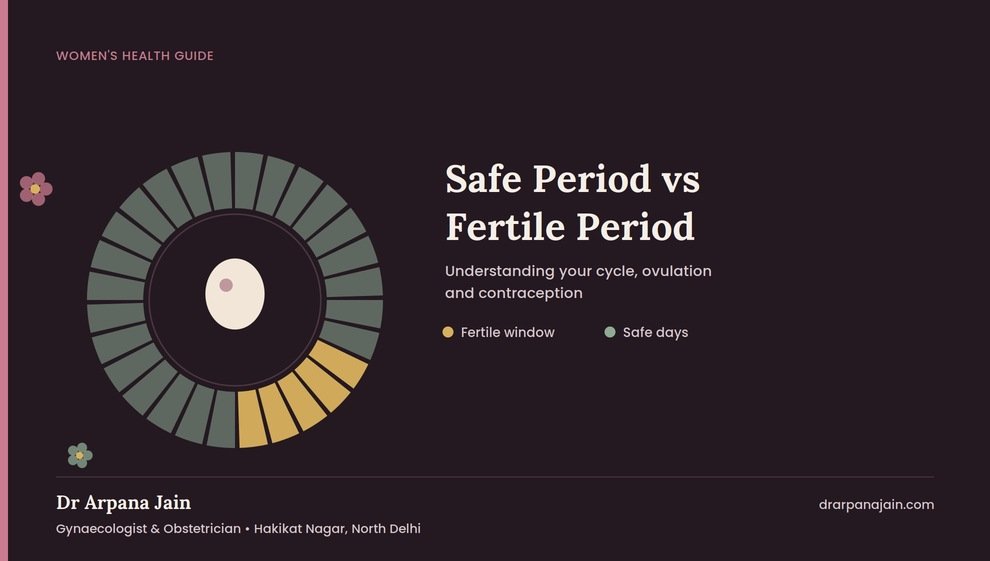
The fertile window is the span of days in your cycle when pregnancy is possible. It includes:
- The 5 days before ovulation (because sperm can survive in the reproductive tract for up to 5 days)
- The day of ovulation itself
- 12–24 hours after ovulation (the lifespan of the released egg)
In a textbook 28-day cycle, this generally falls around Day 10 to Day 17, with the highest chance of conception on the 2–3 days leading up to and including ovulation.
Signs your body may show around ovulation:
- Clear, stretchy, egg-white-like cervical mucus
- A slight rise in basal body temperature (after ovulation)
- Mild one-sided pelvic twinge (mittelschmerz)
- Increased libido in some women
Couples trying to conceive are advised to have intercourse every 1–2 days during this window for the best chance of pregnancy.
What Is the Safe Period?
The “safe period” refers to the days in your cycle when the probability of conception is lowest — broadly, the days furthest from ovulation. This usually includes:
- The first few days of your period and the days immediately after (roughly Day 1–7 in a 28-day cycle)
- The last few days before your next period begins (roughly Day 22–28)
An Important Medical Caution
This is the part every woman should hear directly from her gynaecologist, not just an app or a friend: the “safe period” method (also called the calendar or rhythm method) is one of the least reliable forms of contraception. Its failure rate can be as high as 12–24% with typical use. This is because:
- Cycle length varies month to month for most women, even those who consider themselves “regular”
- Ovulation timing can shift due to stress, illness, travel, weight changes, or hormonal fluctuations
- Sperm survival for up to 5 days means a “safe” day can unexpectedly become fertile
If you are not planning a pregnancy, Dr Arpana Jain recommends discussing more reliable contraceptive options — barrier methods, hormonal contraception, IUDs, or other choices suited to your health profile — during an in-person consultation.
How to Track Your Cycle More Accurately
- Maintain a period diary or app for at least 3–6 months to understand your personal pattern.
- Track basal body temperature each morning before getting out of bed.
- Observe cervical mucus changes through the month.
- Use ovulation predictor kits (OPKs) if you’re actively trying to conceive.
- Get an ultrasound-based follicular study for the most accurate ovulation tracking — especially useful if you have irregular cycles or are undergoing fertility evaluation.
When Should You See a Gynaecologist?
Book a consultation if you notice:
- Cycles shorter than 21 days or longer than 35 days
- No periods for more than 3 months (and you’re not pregnant)
- Very heavy bleeding or severe pain during periods
- Difficulty conceiving after 12 months of trying (or 6 months if you’re over 35)
- Irregular ovulation signs alongside acne, weight gain, or excess hair growth (possible PCOS)
Personalised Guidance from Dr Arpana Jain — North Delhi
Every woman’s cycle is different, and general information can only take you so far. With more than 25 years of experience in Obstetrics & Gynaecology, infertility management, and women’s health, Dr Arpana Jain offers personalised fertility tracking, contraception counselling, and PCOS/irregular cycle management at Hakikat Nagar, North Delhi — easily accessible for patients from Pitampura, Ashok Vihar, Model Town, Rohini, and nearby areas.
To book a consultation or learn more, visit https://drarpanajain.com/
This article is for general educational purposes and is not a substitute for personalised medical advice. Please consult Dr Arpana Jain or your gynaecologist for guidance specific to your health.
Related posts